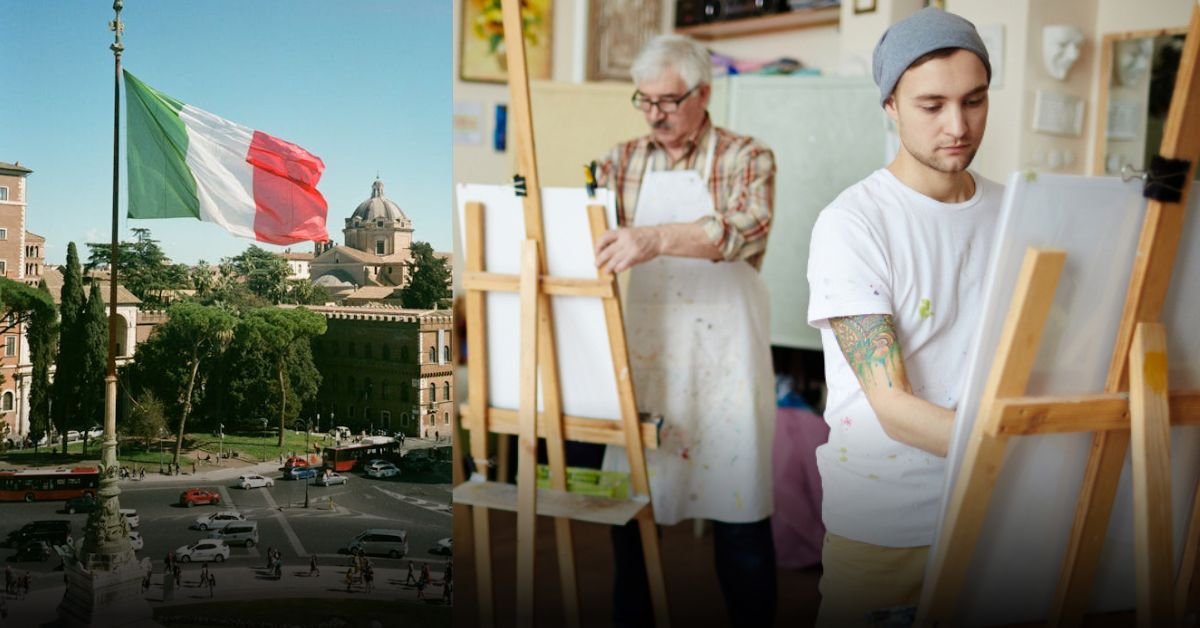
Imagine waking up to the golden light of a Tuscan sunrise, the smell of fresh espresso, and a day ahead dedicated entirely to your craft in the very birthplace of the Renaissance. For many visual artists, Italy is not just a destination; it is a creative necessity. In 2026, the Italian government has unveiled a historic three-year Decreto Flussi (Flow Decree), opening a record 497,550 work spots through 2028. However, for fine artists, the competition is fierce, and the “click day” windows are narrow. This guide breaks down the essential 2026 pathways to help you turn your artistic vision into an Italian reality.
2026 Visa Pathways & Quota Systems
Navigating the Italian quota system is the most significant hurdle for 2026 applicants. Unlike standard employment, self-employment for artists is governed by specific “entry flows.”
- Decreto Flussi (Flow Decree) This is the law that decides how many non-EU workers can come to Italy each year. For 2026, the total is about 165,000 spots. But only around 500 spots are for self-employed people like artists across the whole country. These spots are very limited, so many artists try to get them.
- ALI Portal (Portale Servizi ALI) All applications start on this online portal. In 2026, there are “click days.” On these days, applications go in order of who sends first. You need to be fast.
- Nulla Osta per Lavoro Autonomo This is a paper called “Certificate of No Impediment.” You get it from the Sportello Unico Immigrazione (SUI) before you go to the Italian consulate for your visa.
- Artisti di Chiara Fama (Artists of Renowned Fame) This is the best option for famous artists. If you can show you are known around the world – with big exhibitions, important awards, or famous work – you can get a visa outside the quota. You do not have to compete for the 500 spots. This is like a special path for well-known artists.
Financial & Professional Compliance
Italy wants to know that your art can support you. In 2026, the money rules are clear and based on living costs in Italy.
- €14,000 Capital Requirement This is called Parametri di Riferimento. You must show you have at least €14,000 in money you can use right away. This is three times the minimum for social help. It pays for your start in Italy, like rent or supplies.
- €8,500 Minimum Annual Income You need to prove you made at least this much from art in the last year. Use tax papers to show you can live without help.
- Partita IVA & Regime Forfettario When you arrive in Italy, you open a Partita IVA. This is your VAT number for business. Many artists use Regime Forfettario. It is a simple tax plan. New artists pay only 5% tax for the first five years. This makes it easier to start.
- Codice Fiscale This is your Italian tax ID number. You need it for many things, like renting a studio, buying supplies, or opening a bank account.
Regulatory Bodies & Digital Portals
To do well in 2026, learn the Italian online systems and offices.
- Camera di Commercio (Chamber of Commerce) This office gives a paper about money needs for your type of art. It is important for your application.
- Questura (Police Headquarters) You must go to the local Questura within 8 days after you arrive. There you apply for your Permesso di Soggiorno. This is your residence permit card.
- Agenzia delle Entrate This is the tax office. You register here to start your freelance work in Italy officially.
4. Essential Documentation for 2026
Your art files are very important. In 2026, consulates want a good portfolio that shows you are a real professional artist.
- Artistic Portfolio Put in photos of your work, catalogs from shows, news articles about you, and your CV. Make it digital and printed. It proves your high skills.
- Proof of Accommodation Show a real rent contract or a paper from an Italian person who says you can stay with them.
- Health Insurance For the first visa, buy insurance that covers at least €30,000. After you arrive, you can join the national health system. You pay about 7.5% of your income, but not less than around €387 per year.
- Marca da Bollo This is a €16 stamp for papers. In 2026, you can buy many online.
Summary Table: Key 2026 Financial Data
| Requirement | 2026 Amount/Status | Significance |
|---|---|---|
| Visa Fee (Type D) | €116 | Fee you pay at the consulate. Not returned. |
| Min. Startup Capital | €14,000 | Money you must have ready. Show with bank papers. |
| Annual Income Proof | €8,500+ | From last year’s taxes. Shows you can live. |
| Residence Permit Fee | €126.46 | Includes postal kit and card fees. |
Expert Tip for 2026 Success
The 2026 click days for self-employed spots are in February. The quota is small, only about 500. Many people prepare their forms early on the ALI Portal, starting in late 2025. Be ready and fast. Send your application the second the window opens. Many artists dream of living and working in Italy. The country has amazing history, light, and culture that help creativity. Places like Florence, Rome, and Venice have inspired artists for centuries. With good planning, you can join them.
Start early. Collect your portfolio and money proofs now. Talk to other artists who moved to Italy. Check official websites often for updates. The rules can change a little. If you are a famous artist, use the special path outside quota. It is easier and no limit on spots.
Once in Italy, enjoy the life. Walk in old streets, visit museums, and make new art. Join local art groups. Sell your work in galleries or online. This visa lets you stay long and work free. After some years, you can even get permanent stay.
Would you like a simple step-by-step guide for the 2026 Italian click day? It can help you send your application fast.
Disclaimer: This article is for information only. It is not legal advice. Always check official Italian sites like Visto per l’Italia or talk to a real immigration lawyer before you apply. Rules can change.